The hospital operating system for Indian healthcare
OPD queues, IPD admissions, an AI-based EMR, AI discharge summaries, pharmacy, laboratory, a native PACS DICOM viewer, billing, collection sheets and daily analytics — in one system, on published pricing, live in minutes.
Last updated:
Built for Indian healthcare
- ABDM-compliant (M1–M3)
- DPDP Act aligned
- HDM Policy aligned
- DICOM & HL7 integration
- Local-language EMR
- Multi-site ready
What is HMIS software?
A hospital management information system (HMIS) is software that runs a hospital’s clinical and administrative workflows in one place — patient registration, OPD queues, IPD admissions and beds, the doctor’s EMR, pharmacy and store inventory, laboratory, imaging, billing and insurance, collections, and daily analytics for management. Medikunj is a hospital operating system built for Indian hospitals, nursing homes and clinics, with an AI-based EMR, AI discharge summaries, a native PACS DICOM viewer, a hospital command centre and daily analytics included in the system rather than bolted on as separate purchases.
The problem
Why hospital software usually fails an Indian facility
The problem is rarely a missing feature. It is that the systems do not share a record, so your staff become the integration layer — and money leaks through the gaps between them.
- 1
Revenue leaks quietly, and nobody sees it until month end
A consumable is issued but never billed. A TPA claim is short-documented and rejected. An outstanding due is never chased because nobody was tracking it. Each one is small. Together they are the difference between a good year and a flat one — and none of them show up until the accountant closes the month.
- 2
The same patient is entered three times
Reception enters the patient. The pharmacy enters them again to issue medicine. The billing desk enters them a third time. Every re-entry is a chance for the name, the ID or the charge to diverge, and reconciling those differences becomes somebody's daily job.
- 3
Management is reading history, not running a hospital
Occupancy, department margin, collections and stock exposure arrive weeks after the decisions that shaped them. By the time the report lands, the month it describes is already gone.
Already know what you need?
Medikunj is self-serve — you can be live within minutes of payment.
No implementation project, no consultant to wait for. Book a 20-minute walkthrough, or keep scrolling for the detail.
Capabilities
What Medikunj actually does
One login, one patient record, one operating system. These are the seven capabilities that decide whether a facility's day runs smoothly — and whether its revenue survives the month.
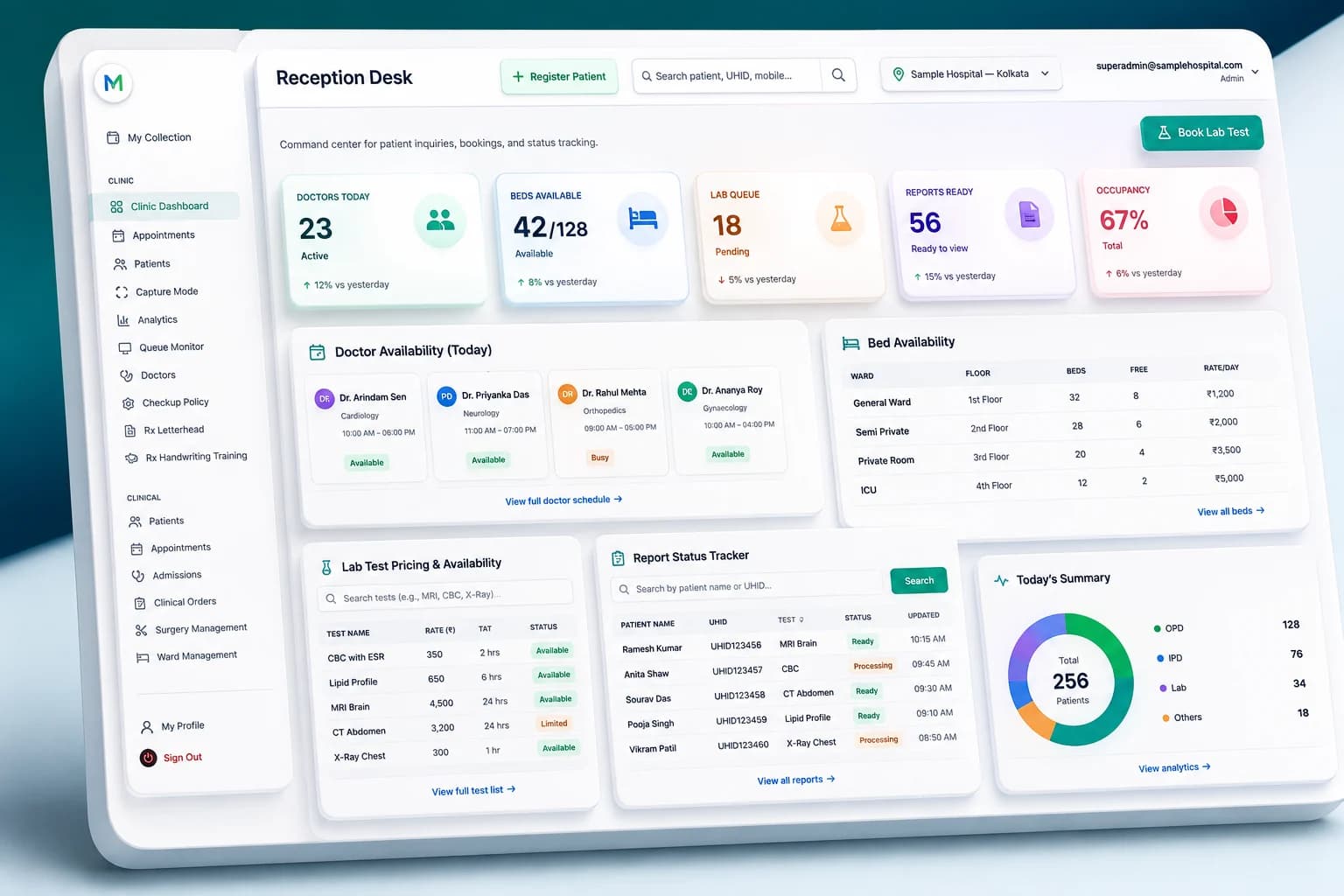
How does Medikunj run the OPD queue?
Medikunj issues live queue tokens to a patient's phone by WhatsApp QR, so the waiting room stops being the queue.
Reception registers the patient, creates or verifies their ABHA, and issues a token. The patient sees their live position on their own phone and can wait outside. Doctors see the same queue on their console and pull the next patient without a call-out.
Reception staff stop managing a crowd and start managing a list.
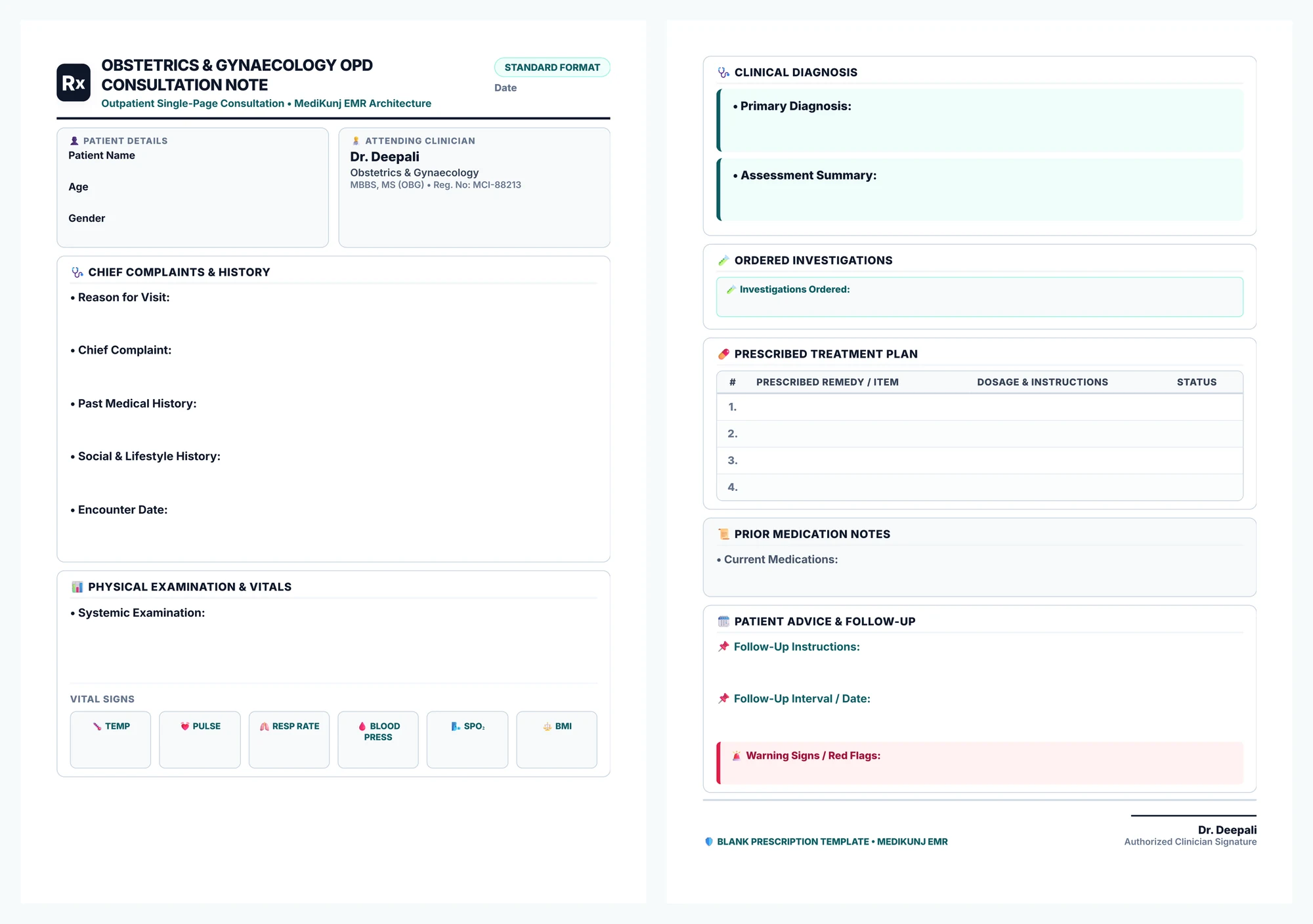
What does the AI-based EMR do during a consultation?
Medikunj gives each doctor a single-screen EMR that listens to the consultation and drafts the prescription, so the doctor edits rather than types.
History, notes, prescription, lab orders and imaging sit on one page with no tab switching. Prescriptions can be dictated by voice, and Indian local-language support means the doctor is not forced into English to record a note. Any status change is reversible in one click, so a mis-tap is not a support ticket.
Consultation notes finish inside the consultation, not after clinic hours.
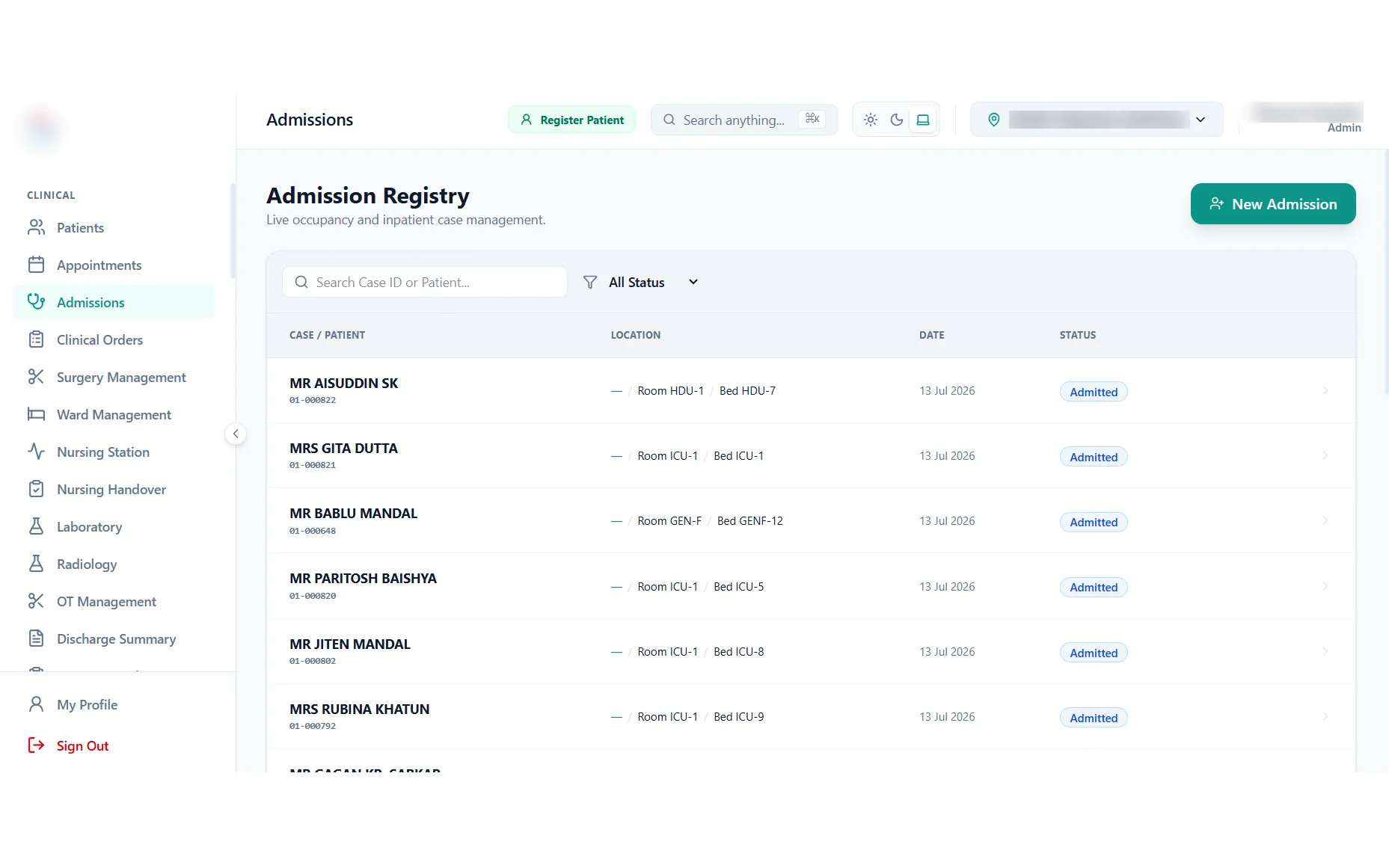
How does Medikunj handle IPD admissions and discharge?
Medikunj maintains a live bed ledger and pharmacy POS summary for every admission and drafts the discharge summary with AI, so discharge is a review step rather than a reconstruction.
Admission, bed transfers, nursing charts, consumables and pharmacy issues all post to the same ledger as they happen. At discharge the bill is already assembled and the AI discharge summary is already drafted from the clinical record — the doctor reviews and signs rather than writing from scratch.
The bed is released while the patient is still at the counter.
Does Medikunj include PACS imaging, or is it a separate system?
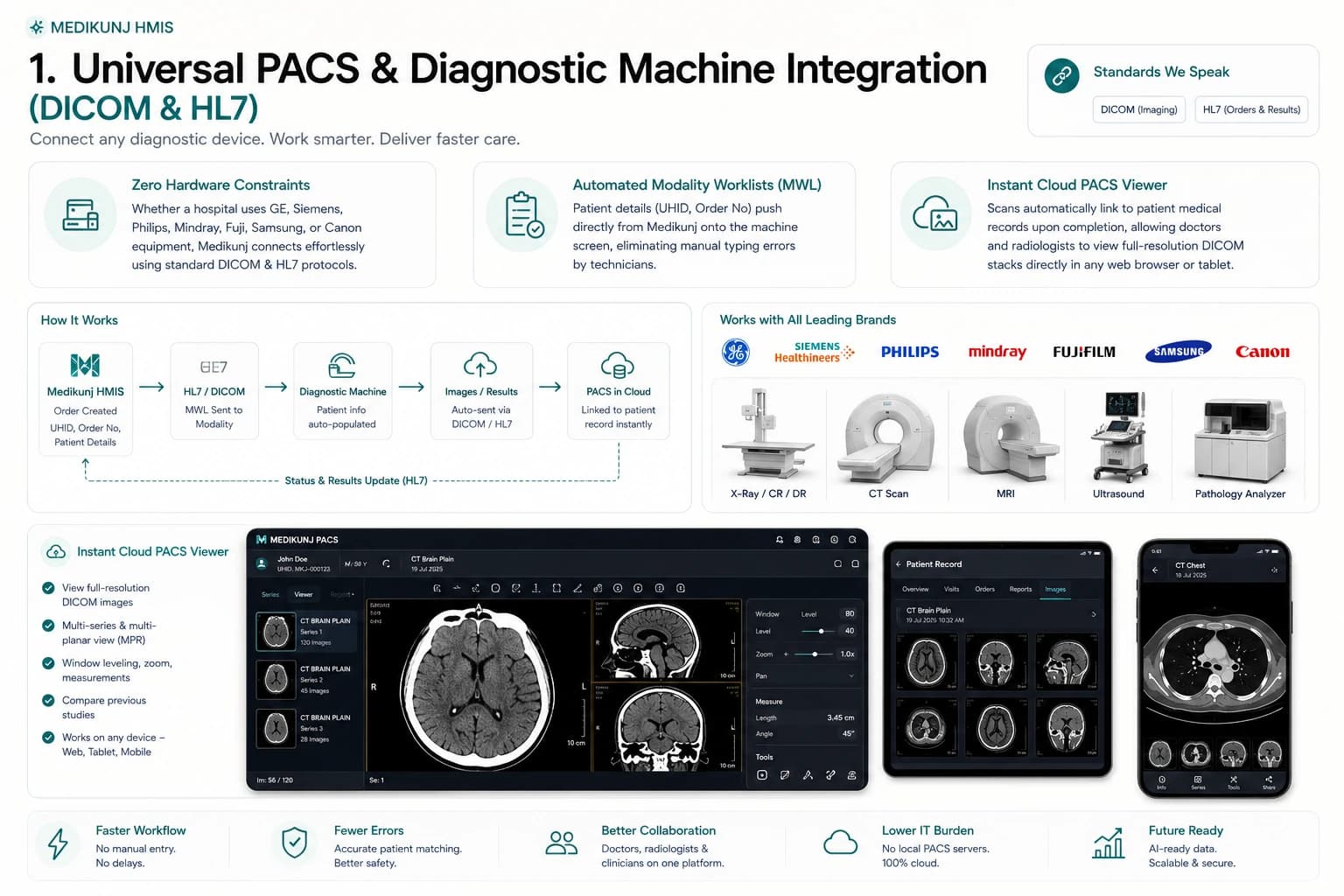
Medikunj includes a native cloud PACS viewer and connects to diagnostic machines over the standard DICOM and HL7 protocols, so there is no separate PACS licence, no local PACS server and no third-party viewer to install.
When an order is created, Medikunj pushes the patient details — UHID, order number, demographics — to the modality as an automated worklist (MWL), so the technician does not retype them at the machine. Images and results come back over DICOM and HL7 and link to the patient record on completion. Doctors and radiologists then open full-resolution DICOM stacks in any web browser or tablet, with multi-series and multi-planar (MPR) view, window levelling, zoom, measurements and comparison against previous studies.
Works with GE, Siemens Healthineers, Philips, Mindray, Fujifilm, Samsung and Canon equipment across X-ray/CR/DR, CT, MRI, ultrasound and pathology analysers.
How does Medikunj stop revenue leaking through pharmacy and stores?
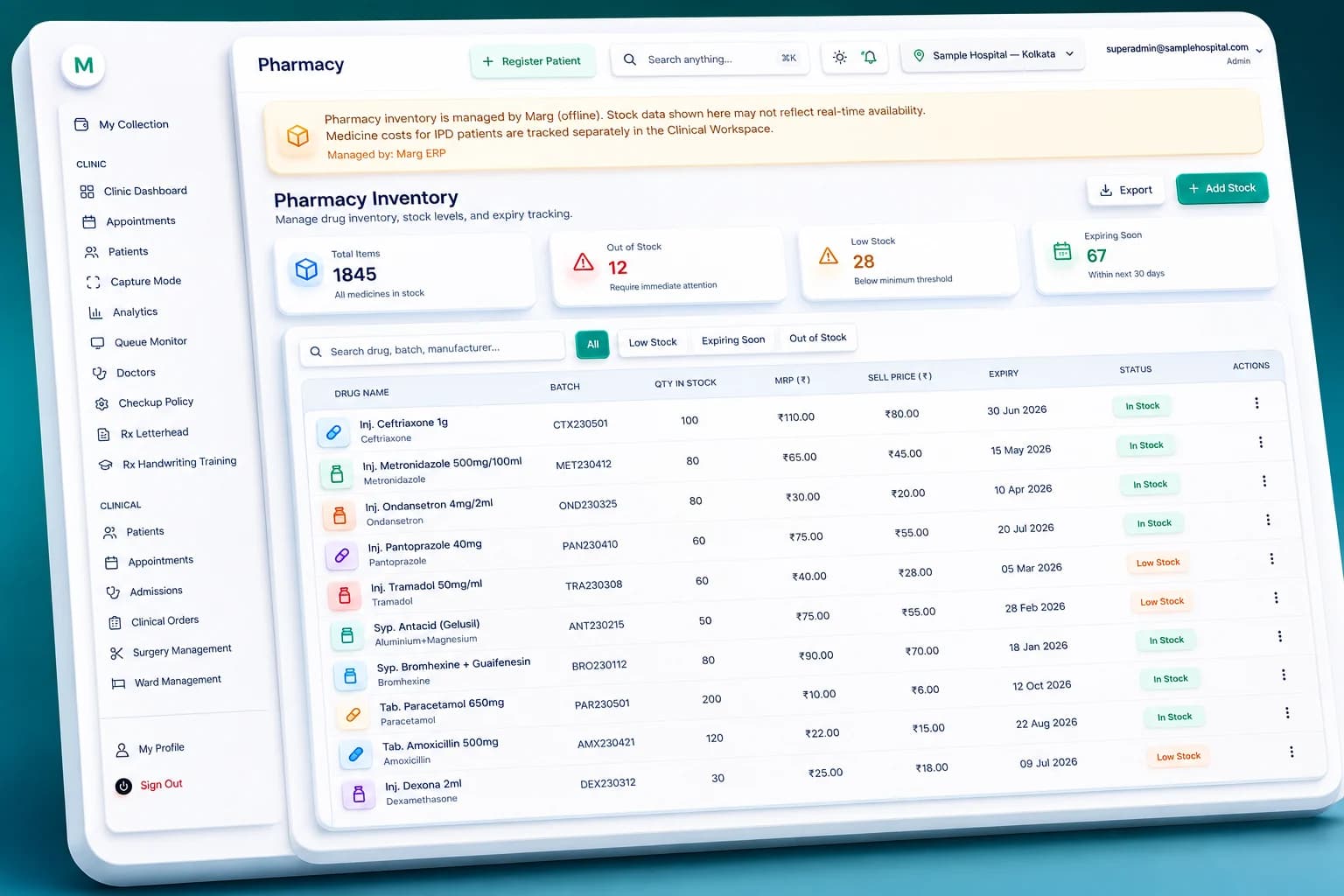
Medikunj runs pharmacy and store inventory on automated FEFO (first-expiry-first-out) logic and posts every issue against the patient's bill at the moment it happens.
That closes the gap where consumables get used but never billed, and where near-expiry stock is discovered only at stock-take. Reorder levels and expiry alerts surface on the same screen the pharmacist already works on.
Consumables that get used, get billed.
Can Medikunj handle cashless TPA, insurance and collections?
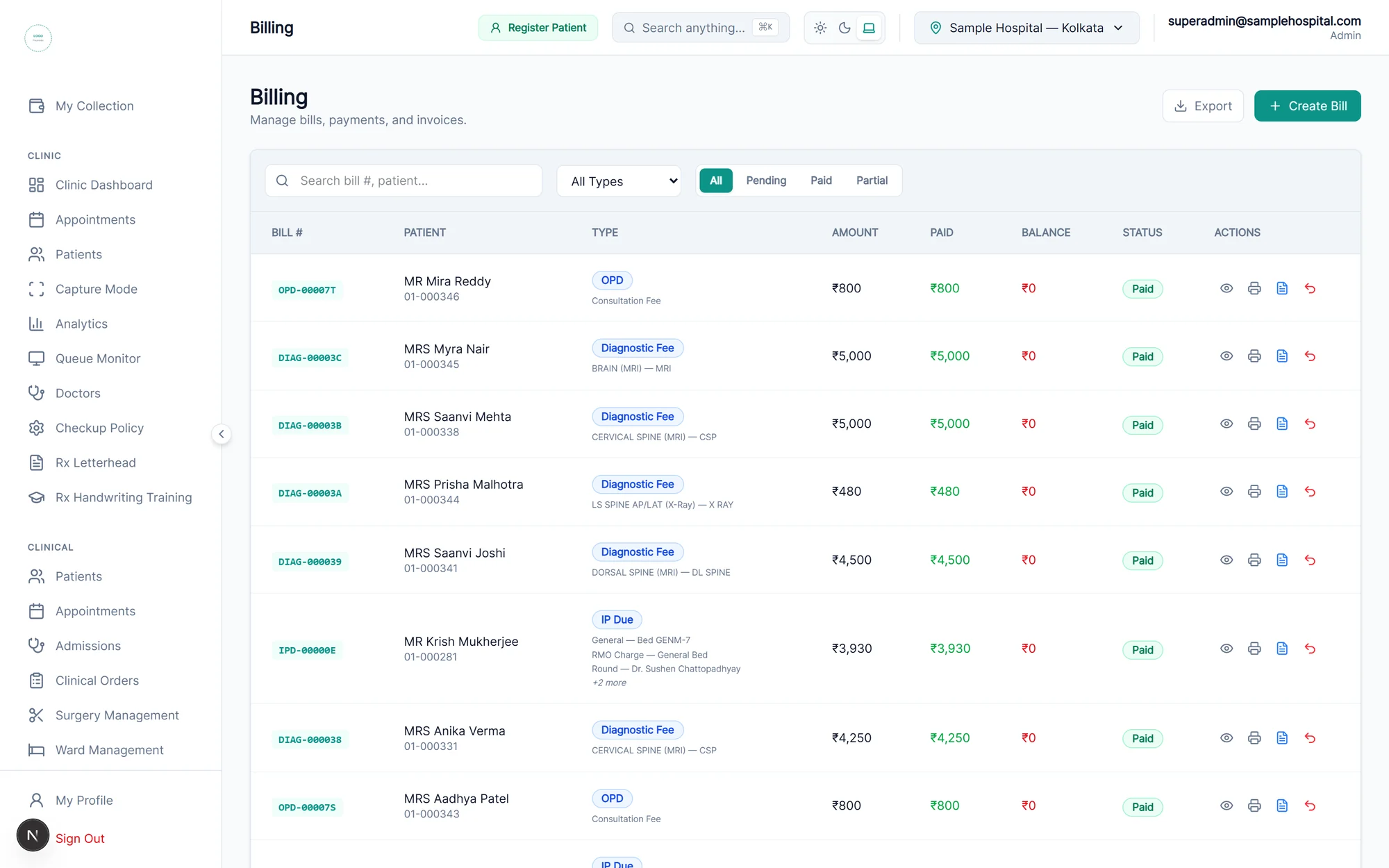
Medikunj assembles cashless TPA and insurance claims from the same records that ran the treatment, and tracks what is still owed on collection sheets.
Pre-authorisation, treatment records, pharmacy issues and investigation reports are drawn from one source, so the documentation matches the clinical file by construction. Outstanding dues — patient, TPA and corporate — sit on collection sheets your billing team can work down daily rather than discovering at month end.
Fewer rejections caused by paperwork rather than clinical grounds.
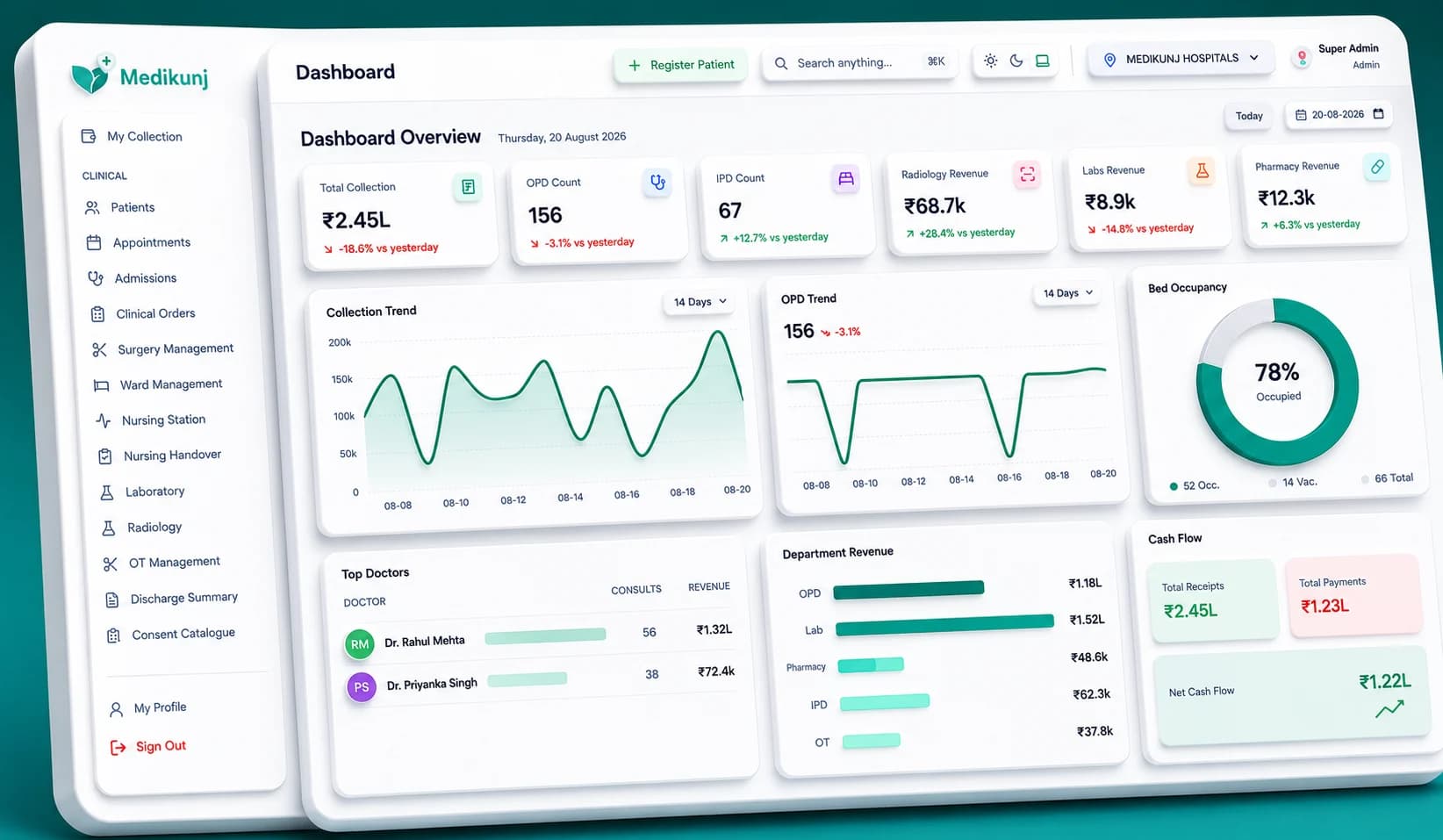
What does the hospital command centre show management?
Medikunj gives management a live command centre with daily analytics on occupancy, revenue, collections, department performance, outstanding dues and stock position.
Because billing, pharmacy, wards and OPD all write to the same system, the dashboard reflects the hospital as it is right now rather than as it was at last month's data entry. Multi-site groups can view each unit separately or consolidated. It is the difference between running a hospital and reading about it four weeks later.
Yesterday's numbers are on your screen this morning, not next month.
The AI layer
The AI layer — and exactly where a human still signs off
Medikunj uses AI where it removes typing, phone calls and month-end guesswork — not where it makes clinical decisions. Every capability below states what the software does and what a clinician still confirms, because in a hospital that distinction is the whole question.
AI prescription drafting
Medikunj listens to the consultation and drafts the prescription — drug, dose, frequency and duration — in the doctor's own prescribing patterns, so the doctor edits rather than types.
Human in the loop: the prescribing doctor reviews and signs every prescription before it is issued. Nothing reaches a patient or a pharmacy unsigned.
AI discharge summaries
The discharge summary is drafted from the admission's own clinical record — course of treatment, investigations, procedures and medication — instead of being written from memory at the end of a shift.
Human in the loop: the treating doctor reviews and signs the summary. The AI assembles what is already in the record; it does not add clinical judgement.
AI voice calls and WhatsApp automation
Appointment confirmations, reminders, follow-up nudges and routine enquiries are handled by voice and WhatsApp automation instead of a person on a phone all day.
Human in the loop: anything clinical, or any call the automation cannot confidently resolve, is escalated to a human at the front desk with the conversation context attached.
AI-powered analytics
Daily analytics surface what changed and what is drifting — collections slowing, a department's margin falling, stock about to expire — rather than leaving you to find it in a report.
Human in the loop: analytics flag and rank; they do not act. Every operational or financial decision stays with your management team.
If a vendor cannot tell you what their AI does when it is wrong, and who catches it, that is the answer to ask harder about. Automation should reduce administrative load without moving clinical responsibility.
Outcomes
What changes, and how we measured it
Numbers without context are worth nothing to a buyer evaluating clinical software, so each figure below states what was measured and where.
~15 min
IPD discharge turnaround
Measured across Medikunj pilot deployments, against a manual baseline of roughly four hours. Varies with hospital size and payer mix.
~45%
Reduction in OPD waiting-room congestion
Measured at pilot sites after introducing WhatsApp QR queue tokens. Depends on OPD volume and clinic layout.
Minutes
From payment to first appointment booked
Self-serve onboarding for a facility starting without legacy data. Facilities migrating existing data go live after migration.
Comparison
Why hospitals switch to Medikunj
The most useful comparison is not another vendor's feature list — it is how the work is done in your facility today, and what it is quietly costing.
| Capability | How it usually works | With Medikunj |
|---|---|---|
| Revenue leakage | Consumables used but never billed; found at stock-take, if at all | Zero-leakage design — every issue posts to the bill and the stock ledger at once |
| Clinical documentation | Handwritten, or typed after clinic hours from memory | AI-based EMR drafts the prescription from the consultation, with Indian local-language support |
| Discharge summary | Written from memory at the end of a shift; patient waits | AI discharge summary drafted from the admission record; doctor reviews and signs |
| Management visibility | Month-end consolidation from several registers | Hospital command centre with live daily analytics across every department |
| Outstanding dues | Discovered at month end, chased from memory | Collection sheets for patient, TPA and corporate dues, worked down daily |
| Revenue & finance | Revenue known only after the accountant closes the month | Revenue, margin and collections visible per department, per day |
| Analytics | Static reports somebody has to build and interpret | AI-powered analytics that rank what changed and what is drifting |
| Imaging | Separate PACS licence, film costs, viewer installed on each machine | Native cloud PACS over DICOM/HL7, automated modality worklists, viewable in any browser or tablet |
| OPD queue | Patients crowd the waiting area; reception calls names over the noise | Live WhatsApp QR queue token on the patient's phone |
| ABHA / ABDM | A separate portal, re-keyed by the front desk | ABHA creation and verification inside the registration screen |
| The system overall | Several tools that do not share a record; staff are the integration layer | One hospital operating system — a copilot that runs the day alongside your team |
| Getting started | Licence negotiation, implementation project, months to go live | Self-serve: pay, configure, start booking appointments the same day |
This table compares Medikunj against common manual and legacy-system workflows in Indian facilities. For a vendor-by-vendor comparison, see our buyer's guide and best-HMIS articles, which name specific platforms and state when each was assessed.
Compliance
ABDM, ABHA and data protection
Medikunj is ABDM-compliant, built to the Milestone M1, M2 and M3 integration specifications published by the National Health Authority: ABHA creation and verification inside the registration screen, linking of visits, admissions, lab reports and prescriptions to the patient’s ABHA address as care contexts, and consent-based retrieval of records held at other facilities.
Medikunj is also built to comply with India’s Health Data Management (HDM) Policy and the Digital Personal Data Protection Act, 2023. If your hospital is empanelled under AB-PMJAY, state health agencies have begun issuing ABDM integration deadlines with financial penalties — our ABDM compliance page sets out what each milestone requires, sourced line by line to NHA documentation.
Fit
Should you get Medikunj?
We could write a careful list of facility sizes here. Instead, here is the honest version.
Medikunj is for you if
- You would like to know today's revenue today, not in four weeks
- You would rather your consumables got billed than written off
- Your doctors have better things to do than type prescriptions
- You think a discharge summary should take minutes, not a shift
- You run diagnostics and would like the DICOM viewer built in, not bought again
- You would like to see the price before the sales call, not after
Give Medikunj a miss if
- You do not want the most affordable serious HMIS available in India today
- You would prefer not to track your hospital's revenue at all
- You feel your doctors should keep typing in a language they do not think in
- You enjoy paying separately for a PACS licence you already thought you had
- You believe pharmacy stock is best tracked in a register nobody reads
- In general, you would like to make a mistake
Straight answers
The questions vendors usually dodge
These six decide most HMIS purchases in India. They are worth asking every vendor you shortlist — including us.
How quickly can we actually start using it?
What happens to the data in our current system?
How much training will our staff need?
What happens when our internet goes down?
Who owns the data, and how do we get it out if we leave?
What does it cost, and what is not included?
Free — use it every month
The Hospital Revenue Leakage Tracksheet
A working spreadsheet for finding the money your hospital is already earning but not collecting. Built to be run monthly by your billing and stores team — not a one-time download you read once and forget.
- The eleven places revenue most commonly leaks in an Indian hospital
- A monthly reconciliation sheet for consumables issued vs consumables billed
- TPA claim rejection tracker with the documentation causes ranked
- Ageing buckets for patient, TPA and corporate outstanding dues
- A simple month-on-month leakage trend you can take to your board
FAQ
HMIS software: common questions
HMIS stands for Hospital Management Information System: software that runs a hospital's clinical and administrative workflows in one place, rather than as separate tools. A full HMIS covers patient registration, OPD queue management, IPD admissions and bed management, the doctor's EMR, pharmacy and store inventory, laboratory, imaging, billing and insurance, collections, and daily analytics for management. Medikunj is a hospital operating system built for Indian hospitals, nursing homes and clinics, with an AI-based EMR, AI discharge summaries, a native PACS DICOM viewer, a hospital command centre and daily analytics included in the system.
An EMR (Electronic Medical Record) is the clinical record of a patient — history, diagnoses, prescriptions, investigations. An HMIS is the whole hospital operating system, of which the EMR is one part; it also covers admissions, beds, pharmacy stock, billing, insurance, collections and daily analytics. A single-doctor clinic may need only an EMR. A facility running wards, a pharmacy, diagnostics or insurance claims needs an HMIS.
Medikunj has four tiers. Entry (₹1,999/month) suits a solo doctor or single-location OPD clinic going paperless — reception, appointments, queue, EMR, prescriptions with AI Scribe, and OPD billing. Growth (₹5,999/month) adds multi-doctor scheduling, pharmacy, laboratory, day care, MRD and revenue analytics for polyclinics and day-care centres. Professional (₹14,999/month) is the full stack for nursing homes and multi-specialty hospitals — IPD and admissions, ward management with a live bed map, nursing station, OT, emergency, radiology, insurance and TPA, and executive dashboards. Custom covers hospital chains needing unlimited branches, blood bank, HL7/FHIR integrations and a dedicated success manager. Annual billing saves 20%; prices exclude GST.
No. Medikunj is used by solo clinics, polyclinics, day-care centres, nursing homes, diagnostic centres and multi-specialty hospitals — the plan does the sizing rather than the product excluding you. Solo practices start on Entry, polyclinics on Growth, nursing homes and hospitals on Professional, and chains on Custom. If you have unusual requirements, raise a personalisation request — our team responds within 24 hours and typically implements within 48 to 72 hours of confirmation.
No. A native cloud PACS viewer is part of Medikunj, and it connects to diagnostic machines over the standard DICOM and HL7 protocols — so it works with GE, Siemens Healthineers, Philips, Mindray, Fujifilm, Samsung and Canon equipment across X-ray, CT, MRI, ultrasound and pathology analysers. Medikunj pushes patient details to the modality as an automated worklist (MWL) so technicians do not retype them, and images link back to the patient record on completion. Doctors view full-resolution DICOM stacks in any browser or tablet with multi-planar view, window levelling, zoom, measurements and comparison against prior studies. This removes a separate PACS licence, local PACS servers, film costs and per-machine viewer installation — which is why diagnostic centres often adopt Medikunj for imaging alone.
Yes. Medikunj is ABDM-compliant, built to the Milestone M1, M2 and M3 integration specifications published by the National Health Authority — ABHA creation and verification at registration, linking of health records to the patient's ABHA address, and consent-based retrieval of records held at other facilities. Our ABDM compliance page sets out what each milestone requires, sourced to NHA documentation.
Yes. Medikunj supports multi-site organisations with separate schedules, billing, collections and reporting per location, while maintaining a unified patient record across sites. The hospital command centre can show each unit individually or consolidated.
Registration and OPD queue workflows continue locally during a connectivity loss and sync when the connection returns. When evaluating any cloud HMIS in Indian conditions, ask specifically what the software does at the moment the connection drops — not only what it does when the connection is good.
If you are a new hospital or have no prior data to bring across, implementation takes minutes: pick your plan on the pricing page — Professional is the usual choice for a nursing home or hospital — configure your departments, and start booking appointments immediately. If data migration is involved, the time depends on the state of your existing data structure, and Medikunj offers free data migration; book a demo slot to start it.
Medikunj publishes four tiers: Entry ₹1,999/month, Growth ₹5,999/month, Professional ₹14,999/month, and Custom on request. Annual billing saves 20%, and all prices exclude 18% GST. Module add-ons are listed at fixed prices — ₹1,999/month each for laboratory, radiology, pharmacy, blood bank or an additional branch, and ₹1,499/month for an extra doctor seat plus five staff seats. There is no percentage-based annual maintenance on licence value, no separate PACS licence, and no implementation, migration or training charge appearing after signature. The published price is the price.
Medikunj provides daily analytics through a hospital command centre: occupancy, revenue and margin by department, collections and outstanding dues, OPD and IPD throughput, and stock position including expiry exposure. Because billing, pharmacy, wards and OPD write to the same system, the numbers reflect the hospital as it is today rather than as it was at last month's data entry.
Keep reading
Where to go next
Everything below is on medikunj.com, written by the team that builds the software.
See it running your hospital's actual workflow
A 20-minute working screen-share — registration, consultation, ward, pharmacy, discharge, collections and the command centre, with data that looks like yours. No slide deck, no obligation.