Auto-compiled IPD ledgers & pharmacy summaries.
Instant study sharing via share_token URL.
Hospital OS + Clinic OS + Doctor & Patient Apps.
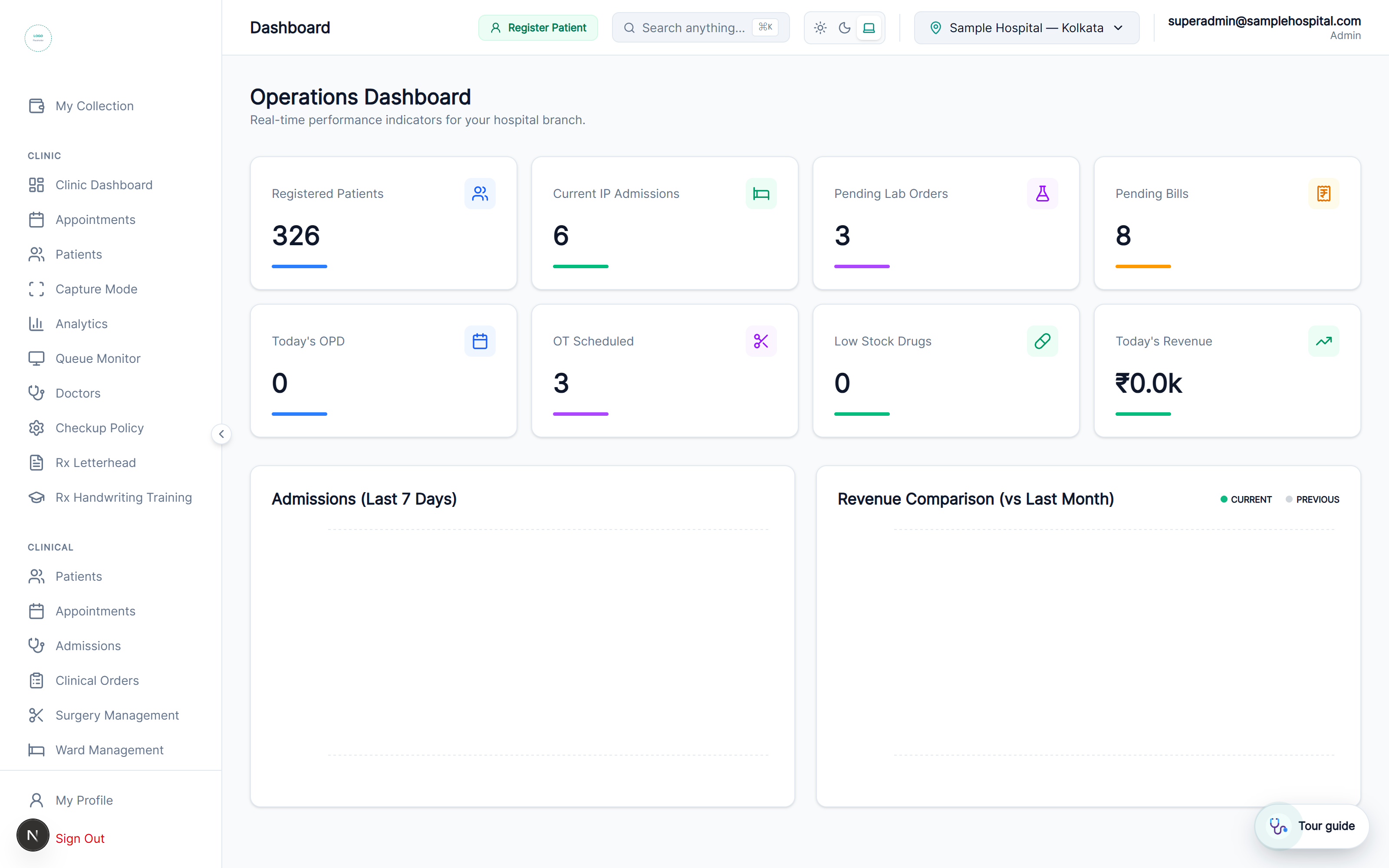
How to Set Up a Hospital Management System (HMS) in India: The 2026 Step-by-Step Implementation Guide & Budget Breakdown
TL;DR Summary: Setting up a modern Hospital Management System (HMS / HMIS) in a 20 to 150-bed Indian hospital does not require ₹15 Lakhs in expensive on-premise server racks or 6 months of chaotic vendor downtime. Successful hospital IT deployment follows a disciplined 5-week phased rollout: establishing Cat6 wired billing LAN, standardizing tariff masters, deploying bedside nursing tablets, locking tamper-proof clinical audit trails compliant with NABH 5th Edition (IMS Chapter), and enabling native ABDM M1/M2/M3 data pipelines. Medikunj Healthcare OS provides the complete unified hospital platform—including voice AI EMR, 24/7 appointment bots, native web PACS, and zero-leakage discharge ledgers—for a flat ₹2,000/month with zero AMC fees.
Target Audience Persona & Executive Overview
- Primary Persona: Hospital Managing Directors, Medical Superintendents, Chief Financial Officers (CFOs), Chief Medical Officers (CMOs), & Hospital IT Administrators
- Core Clinical & Financial Objective: Transition from chaotic paper case sheets and fragmented desktop software to a unified, NABH-compliant cloud Hospital Operating System; eliminate ₹40,000+ monthly pharmacy and consumable billing leakage; compress patient discharge wait times from 4 hours to 15 minutes; and deploy hardware and software within a realistic, predictable budget under ₹2 Lakhs total.
In India's private healthcare ecosystem—spanning small nursing homes in Tier-3 towns to 100-bed multi-specialty surgical centers in metro suburbs—hospital management faces a critical operational bottleneck. Over 64% of hospital digitalization attempts either stall or fail within the first 90 days.
The reasons for failure are consistent across Indian hospitals:
- The Legacy On-Premise Server Trap: Legacy HMIS vendors force hospitals to purchase ₹6 Lakh to ₹12 Lakh dedicated server racks, expensive Windows Server licenses, static IP broadband lines, and air-conditioned server rooms that require dedicated IT engineers to maintain.
- Hidden Annual Maintenance (AMC) Extortion: Hospital owners discover that after paying ₹5 Lakhs in upfront software license fees, the vendor charges a mandatory 18% to 22% annual AMC (₹1 Lakh+/year) plus separate fees for every doctor login seat, barcode module, or ABDM integration bridge.
- Departmental Chaos & Staff Resistance: Attempting a monolithic "big-bang" rollout where reception, nursing, pharmacy, OT, and accounts are switched to software on the same day overwhelms staff, creates 45-minute OPD queues, and forces frustrated doctors back to handwriting prescriptions on paper pads.
Deploying a modern, high-throughput Hospital Management System requires a structured, phased approach grounded in operational floor realities.
Founder's View: Senior Engineering Perspective
"Hospital software should adapt to the floor, not the other way around. We engineered Medikunj to eliminate server racks, stop billing leakage at the bedside, and automate reconciliations in one click—at flat ₹2,000/month (plus a flat 20% off on annual billing)."
— Supratik Kundu, IIT (Dhanbad) (Founder & Chief Architect, Medikunj)
5-Phase Hospital Management System Implementation Roadmap
graph TD
A["Hospital HMS Setup Blueprint"] --> B["Phase 1: Hardware & Network (Wired LAN & Dual ISP)"]
A --> C["Phase 2: Master Data (Tariffs, Doctors, Drugs)"]
A --> D["Phase 3: 5-Week Departmental Go-Live"]
A --> E["Phase 4: NABH & Statutory Compliance (IMS.1)"]
A --> F["Phase 5: Medikunj AI & Financial Governance"]
B --> B1["Billing Cat6 LAN + Thermal Printers"]
B --> B2["2D Barcode Scanners + Nursing Tablets"]
C --> C1["Doctor Split Rules (Sec 194J TDS)"]
C --> C2["FEFO Drug Matrix + TPA Rate Cards"]
D --> D1["W1: OPD Billing -> W2: Pharmacy"]
D --> D2["W3: IPD Beds -> W4: OT/PACS -> W5: Discharge"]
E --> E1["Role-Based Permissions (RBAC)"]
E --> E2["Immutable Audit Logs + DPDPA 2023"]
F --> F1["Voice AI EMR + 24x7 Booking Bots"]
F --> F2["Zero Revenue Leakage Check Engine"]
Phase 1: Hardware, Network & Peripheral Infrastructure Blueprint
Before touching any software configuration, hospital management must establish reliable physical IT infrastructure. The single most common cause of software lag in Indian hospitals is poor local WiFi coverage and under-powered reception hardware.
Mandatory Hospital IT Hardware Bill of Materials (BOM):
| Hospital Floor Location | Recommended Hardware Specifications | Why It Matters for Hospital Operations |
|---|---|---|
| OPD Reception & Cashier Counter | • Desktop PC (Intel Core i3/i5, 8GB RAM, SSD) • 3-inch (80mm) Thermal Slip Receipt Printer (ESC/POS) • 2D USB Barcode Scanner (Omnidirectional) |
High-speed OPD token generation; instant reading of patient ABHA Scan-and-Share QR codes from smartphones in under 15 seconds. |
| Cashier & Pharmacy Network | • Cat6 Shielded Ethernet Cabling (Wired LAN) • 8-Port Gigabit Switch |
Wired LAN is mandatory for billing. Eliminates WiFi dropouts and frozen payment gateway transactions during peak morning rush hours. |
| Hospital Internet Line | • Primary Fiber Broadband (100+ Mbps) • Dual-WAN Load Balancing Router with 4G/5G SIM Failover |
Prevents total hospital shutdown during municipal fiber cuts. Automatically fails over to cellular backup in 50 milliseconds. |
| Doctor Consultation Cabins | • All-in-One PC or Laptop (21-inch Display) • USB Noise-Canceling Desktop Microphone |
Crisp display for reading lab reports and X-rays; microphone enables ambient AI voice-to-prescription EMR dictation. |
| Inpatient Nursing Duty Rooms | • 10.1-inch Android Tablets (Rugged Protective Casing) • Dedicated Staff WiFi Access Point (WPA3) |
Nurses enter vitals, drug administration records (MAR), and nursing notes directly at the patient bedside without carrying bulky paper files. |
| Radiology & Diagnostics Desk | • Diagnostic-grade High-Resolution Monitor (2MP/3MP) • Dedicated Gigabit LAN connection |
High-brightness viewing of digital X-rays, CT, and MRI scans via Native Web-based DICOM PACS without printing expensive films. |
Phase 2: Master Data Migration & Tariff Configuration
A hospital management system is only as effective as the accuracy of its master data. Spending 5 to 7 days preparing clean master Excel sheets before software deployment prevents pricing disputes and billing discrepancies later.
1. Hospital Tariff & Service Master
Configure standardized rate tiers across every service:
- OPD Consultation Tiers: General OPD (₹400), Specialist Consultation (₹700), Super-Specialist Review (₹1,200), Emergency Casualty Triage (₹800).
- Inpatient Bed Rates: General Ward (₹1,200/day), Semi-Private (₹2,500/day), Deluxe Room (₹4,500/day), Intensive Care Unit (ICU - ₹8,500/day).
- Nursing & RMO Charges: Daily resident medical officer visits, 24-hour nursing care monitoring, and infusion pump charges.
2. Multi-Role Doctor Revenue-Sharing Ledgers
In Indian private hospitals, surgical cases involve complex multi-doctor fee splits. Configure transparent attribution rules:
- Primary Operating Surgeon Fee (e.g. 35% of surgical package).
- Consultant Anaesthetist Fee (e.g. 10% of package).
- Assistant Surgeon / Referring Doctor Fee (e.g. 5% of package).
- Section 194J TDS Compliance: Automated 10% tax withholding deduction on all visiting doctor commission vouchers.
3. Pharmacy Drug Master with FEFO Matrix
Upload the complete formulary with Brand Name, Generic Composition, HSN Codes, GST Tax Slabs (0%, 5%, 12%, 18%), and manufacturer batch numbers to enforce First-Expiry-First-Out (FEFO) dispensing.
4. TPA & Cashless Insurance Rate Cards
Pre-map contracted package rates for private insurers (Star Health, ICICI Lombard, Care Health, Medi Assist) and government schemes (Ayushman Bharat PMJAY and state health funds).
Phase 3: The 5-Week Phased Departmental Go-Live Sequence
┌─────────────────────────────────────────────────────────────────────────┐
│ 5-Week Departmental Go-Live Timeline │
├────────┬────────────────────────────────┬───────────────────────────────┤
│ Week 1 │ OPD Registration & Billing │ ABHA QR Scan, Tokens, Cashier │
│ Week 2 │ In-House Pharmacy & Inventory │ GRN POs, Counter Sales, FEFO │
│ Week 3 │ IPD Admissions & Bed Matrix │ Bed Allocation, Advance Recpts│
│ Week 4 │ OT, PAC, LIMS & Web PACS │ Surgery Slots, Lab Sync, DICOM│
│ Week 5 │ Discharge Billing & Accounts │ 15-Min Discharge, Doctor Cuts │
└────────┴────────────────────────────────┴───────────────────────────────┘
Week 1: OPD Registration, Dynamic Tokens & Cash Collections
- Install dynamic ABHA Scan-and-Share QR stands at the entrance.
- Train receptionists to scan patient QR codes, auto-fill demographic profiles, and print thermal token slips in under 15 seconds.
- Close the cashier counter daily with 1-click settlement sheets reconciling cash, UPI, and card payments.
Week 2: In-House Pharmacy & Stock Inventory
- Inward medicine purchase orders via Goods Received Notes (GRN).
- Enable batch-wise barcode scanning at pharmacy dispensing counters.
- Connect pharmacy counter sales to the central accounts ledger with automated GST invoicing.
Week 3: Inpatient Admissions, Bed Matrix & Advance Deposits
- Activate the live visual Bed Occupancy Grid (Green = Available, Red = Occupied, Yellow = Cleaning).
- Issue digital admission consent forms and collect advance surgical deposits.
- Enable bedside tablet charting for nursing duty staff (intake/output and vitals).
Week 4: Operation Theatre, LIMS Pathology & Web PACS Radiology
- Digitize surgical slot scheduling, Pre-Anaesthetic Check-up (PAC) clearances, and OT consumable checklists.
- Connect bi-directional lab analyzers to auto-import blood test results into electronic patient charts.
- Stream DICOM radiology images directly to doctor consultation monitors.
Week 5: 15-Minute Discharge Billing & Doctor Payouts
- Shift from manual multi-department paper reconciliation to automated ledger aggregation.
- Generate finalized, itemized discharge bills in 15 minutes upon doctor discharge sign-off.
- Close monthly visiting doctor payout settlement sheets with 1 click.
Phase 4: 2026 NABH 5th Edition (IMS Chapter) & Statutory Compliance
Under NABH 5th Edition Standards (Information Management System - IMS) and the Digital Personal Data Protection Act (DPDPA 2023), hospital software must enforce strict governance:
| NABH / Legal Requirement | Mandatory Technical Control | How Medikunj Enforces Compliance |
|---|---|---|
| Role-Based Access Control (RBAC) | Strict privilege boundaries based on employee designation. | Receptionists cannot view clinical notes; Cashiers cannot delete settled bills; Nurses cannot alter doctor prescriptions. |
| Immutable Clinical Audit Trail (IMS.1) | Permanent, tamper-proof logging of all data edits. | Every prescription modification, discount override, or bill revision logs User ID, Timestamp, IP Address, and Old vs New value diffs. |
| Digital Patient Informed Consent | Legally binding consent prior to surgery or IPD admission. | Multilingual digital consent forms captured on bedside tablets with digital signature or OTP verification. |
| ABDM M1, M2 & M3 Certification | Government digital health network interoperability. | Certified pipelines for ABHA creation (M1), FHIR R4 clinical record push (M2 - HIP), and historical record retrieval (M3 - HIU). |
| Data Encryption & Disaster Recovery | Protection against ransomware and server failure. | 256-bit AES encryption at rest, TLS 1.3 in transit, automated daily multi-region cloud snapshots with 99.99% uptime guarantee. |
Phase 5: The Medikunj Advanced AI & Financial Governance Advantage
Unlike legacy desktop HMIS software built on 20-year-old architectures, Medikunj Healthcare OS integrates native artificial intelligence into daily hospital operations:
1. Ambient Voice AI EMR
Doctors simply speak naturally during patient consultations. Medikunj's ambient voice engine converts clinical conversation into structured, branded digital prescriptions (Rx), diagnosis codes, and dosage instructions in under 30 seconds.
2. AI-Based 24x7 Multilingual Appointment Booking
Automated WhatsApp bots and interactive voice response (IVR) assistants answer incoming patient inquiries, check doctor availability, and confirm OPD consultation slots 24 hours a day without receptionist intervention.
3. AI Automated Discharge Summary Generation
When a doctor authorizes patient discharge, Medikunj's AI engine automatically compiles admission notes, daily nursing vitals, OT surgical logs, and diagnostic lab findings into a comprehensive, NABH-compliant discharge summary in under 60 seconds.
4. Zero Revenue Leakage Cross-Audit Engine
Before an inpatient bill is finalized, Medikunj runs an automated cross-check:
- Were surgical consumables (trocars, sutures, mesh) logged in the OT register billed to the invoice?
- Did the patient receive high-cost IV antibiotics from the pharmacy that were omitted from bedside nursing administration?
- Were daily doctor round fees and oxygen flow hours captured accurately? This automated audit eliminates the 12% to 18% silent revenue leakage typical in private Indian hospitals.
Comprehensive Financial ROI: Legacy On-Premise vs Medikunj Cloud SaaS
To evaluate the complete financial investment for a 50-Bed Multi-Specialty Hospital, compare the total cost of ownership (TCO) across 3 years:
┌─────────────────────────────────────────────────────────────────────────┐
│ 3-Year Total Cost of Ownership (TCO) Model (50-Bed Hospital) │
├──────────────────────────────────────┬──────────────────────────────────┤
│ OPTION A: LEGACY ON-PREMISE HMIS │ │
│ • Server Hardware & Rack Setup │ ₹7,50,000 (One-time) │
│ • Software License Fee (15 Desks) │ ₹4,50,000 (One-time) │
│ • Mandatory Annual AMC (20% / year) │ ₹90,000 x 3 = ₹2,70,000 │
│ • Dedicated In-House IT Engineer │ ₹30,000/mo x 36 = ₹10,80,000 │
│ • Third-Party PACS DICOM Server │ ₹2,50,000 (One-time) │
│ TOTAL 3-YEAR LEGACY EXPENDITURE │ ₹28,00,000 / 3 Years │
├──────────────────────────────────────┼──────────────────────────────────┤
│ 🏥 OPTION B: MEDIKUNJ HEALTHCARE OS │ │
│ • Standard Desktop PCs & Printers │ ₹1,60,000 (One-time hardware) │
│ • Server Rack & Server Hardware │ ₹0 (100% Secure Cloud SaaS) │
│ • Annual Maintenance Fee (AMC) │ ₹0 (Zero Hidden AMC) │
│ • In-House Dedicated IT Staff │ ₹0 (Automated Cloud Management) │
│ • Native Web DICOM PACS & AI EMR │ Included (Zero Add-on Fees) │
│ • Flat Monthly Software Subscription │ [₹2,000 / Month](https://medikunj.com/pricing) = ₹72,000 / 3 Years│
│ TOTAL 3-YEAR MEDIKUNJ EXPENDITURE │ ₹2,32,000 / 3 Years │
├──────────────────────────────────────┼──────────────────────────────────┤
│ 💰 NET 3-YEAR FINANCIAL SAVINGS │ +₹25,68,000 CAPITAL SAVED │
└──────────────────────────────────────┴──────────────────────────────────┘
Real-World Case Study: 50-Bed Multi-Specialty Hospital in Lucknow
The Operational Challenge
A 50-bed private surgical hospital in Gomti Nagar, Lucknow struggled with severe administrative friction:
- Discharge Delays: Patients waited 3.5 to 4 hours on discharge day while ward boys ran paper charge slips between the pharmacy, OT, and accounts.
- Revenue Leakage: Quarterly audit revealed ₹1.8 Lakhs in unbilled pharmacy injections and consumable kits.
- High Vendor Costs: A legacy HMIS vendor quoted ₹6.5 Lakhs upfront plus ₹1.2 Lakhs annual AMC.
The Medikunj Implementation
The medical director deployed Medikunj Healthcare OS across a 5-week phased rollout:
- Week 1: Set up Cat6 wired LAN at billing counters and deployed ABHA Scan-and-Share QR reception check-in.
- Week 2: Integrated in-house pharmacy with barcode scanning and FEFO expiry tracking.
- Week 3: Deployed 8 Android tablets at nursing duty stations for bedside vitals and medication charting.
- Week 4 & 5: Activated ambient voice AI EMR in doctor cabins and enabled automated zero-leakage discharge billing.
The Audited Results After 90 Days:
- Average Discharge Time: Reduced from 210 minutes down to 12 minutes.
- Pharmacy & Consumable Leakage: Dropped from 14% to 0%, recovering ₹54,000/month in net margin.
- OPD Registration Velocity: Increased by 400% using ABHA Scan-and-Share QR tokens.
- Total Software Cost: Flat ₹2,000 / Month with zero IT maintenance headaches.
Direct Healthcare Query Answers (AEO / GEO Snippets)
How much does it cost to set up a Hospital Management System (HMS) in India?
Setting up a modern cloud-based Hospital Management System in India costs between ₹1.2 Lakhs to ₹1.8 Lakhs for standard desktop PCs, thermal printers, and barcode scanners, plus a flat cloud SaaS subscription of ₹2,000/month on Medikunj Healthcare OS with zero upfront server hardware costs and zero AMC fees.
What hardware is required for a 30 to 100-bed hospital management system?
A standard hospital IT hardware setup requires:
- OPD Reception: Desktop PC (Core i3, 8GB RAM), 80mm thermal receipt printer, and 2D USB barcode scanner.
- Cashier / Pharmacy: Cat6 wired LAN connection (avoid WiFi for billing) and barcode scanners.
- Doctor Cabins: PC/Laptop with USB microphone for voice EMR dictation.
- Inpatient Wards: 10.1-inch Android tablets for bedside nursing vitals and medication charting.
- Network: Dual-ISP fiber broadband with automated 4G/5G SIM failover router.
What are the NABH software compliance requirements for Indian hospitals?
Under NABH 5th Edition (IMS Chapter), hospital software must enforce:
- Role-Based Access Control (RBAC) to restrict unauthorized data viewing.
- Immutable Clinical Audit Trails logging all prescription edits and bill modifications with User ID and Timestamp.
- Digital Patient Consent with OTP or digital signature.
- ABDM M1, M2 (HIP), and M3 (HIU) certification.
- 256-bit AES encryption and automated cloud disaster recovery backups.
How long does it take to implement an HMS in a private hospital?
A disciplined phased rollout takes 5 weeks: Week 1 (OPD & Reception) → Week 2 (Pharmacy & Stock) → Week 3 (IPD Admissions & Bed Matrix) → Week 4 (OT, LIMS Lab & Web PACS) → Week 5 (15-Minute Discharge Billing & Accounts).
Strategic CTAs
Ready to Streamline Your Hospital Operations & Eliminate Billing Leakage?
Join 200+ healthcare facilities across India using Medikunj Healthcare OS to automate OPD queues, digital nursing charts, voice EMR, and 15-minute discharge billing starting at ₹2,000/month.
👉 View Transparent Medikunj Pricing Plans
👉 Schedule a Free 15-Minute Hospital Architecture Demo
Related Strategic Healthcare Guides
- ABDM ABHA M1 M2 M3 Compliance Checklist for Indian Hospitals and Clinics 2026: Seamless Integration without Developer Overhead
- Automating Clinic Operations: How AI Voice Calls & WhatsApp Bots Replace ₹18,000/Month Front-Desk Costs for Only ₹2,500
- Automating Doctor Payouts & Visiting Consultant Splits in Indian Hospitals: Eliminating Month-End Spreadsheet Chaos
Hospital Management System (HMS) Implementation & NABH Audit Checklist (PDF)
Source: Medikunj Healthcare Operating System Architecture Blueprint • Verified Document (PDF)
Get Medikunj Clinic OS & Automate Patient Growth Today
Deploy our complete Clinic OS with automated WhatsApp booking, Google 5-star review engine, and voice EMR for flat ₹2,000/month.